
Silent Springdale
The low, dystopian hum of an AI Data Center descends upon a riverfront site that could have commemorated the life of America’s most influential environmentalist.


On the banks of the Allegheny River, just north of Pittsburgh, sits the small town of Springdale. On the leafy streets of Springdale, there sits an old wooden farmhouse, painted white with green shingles. In the old wooden farmhouse, a young girl grew up in the early 1900s, exploring the surrounding forests while cultivating a sense of wonder about all the beauty and complexity of the natural world. That little girl was Rachel Carson. Rachel would grow up to pen the influential science book Silent Spring, educating the world about the unpredictable systemic threats of pesticide use, a bestseller that would inspire the emergence of the modern environmentalist movement.
Like many towns nestled within the Allegheny Valley, Springdale fell on hard times in the late 20th century. The population of Springdale today is little more than half of what it was when its most famous resident, Rachel Carson, published Silent Spring in 1962. The factories that once provided jobs and wages for the people of Springdale would go the way of rust and dust. Yet in a community blessed with such natural beauty and rich history, deindustrialization offered an opportunity to restore and remold Springdale into a community embodying the spirit of Rachel Carson. There was no site in Springdale more enticing for green redevelopment than the 200 acres of riverfront property opened up by the demolition of the coal-powered Cheswick Generating Station earlier this year. There were real hopes that the site would be used to honor Carson’s legacy, leveraging Springdale’s unique status as the only place on earth that could claim arguably history’s greatest environmentalist as its native daughter. Last September, the Pittsburgh Tribune Review reported, “The township…envisions turning the properties into an environmental, educational and recreational area — tapping into the history of Springdale native and world-renowned environmental researcher Rachel Carson.” Large public building projects are not so easily executed in this day and age. But for just a fraction of $1.6 billion in tax benefits that the State of Pennsylvania kicked in to help Shell build a fracking-fueled plastic plant on the Ohio River, a world-class facility could have been built in Rachel Carson’s honor, employing hundreds, drawing in tourists and academics from across the globe, injecting unprecedented levels of new energy and revenue into a town struggling to provide public services and revitalize its business district.
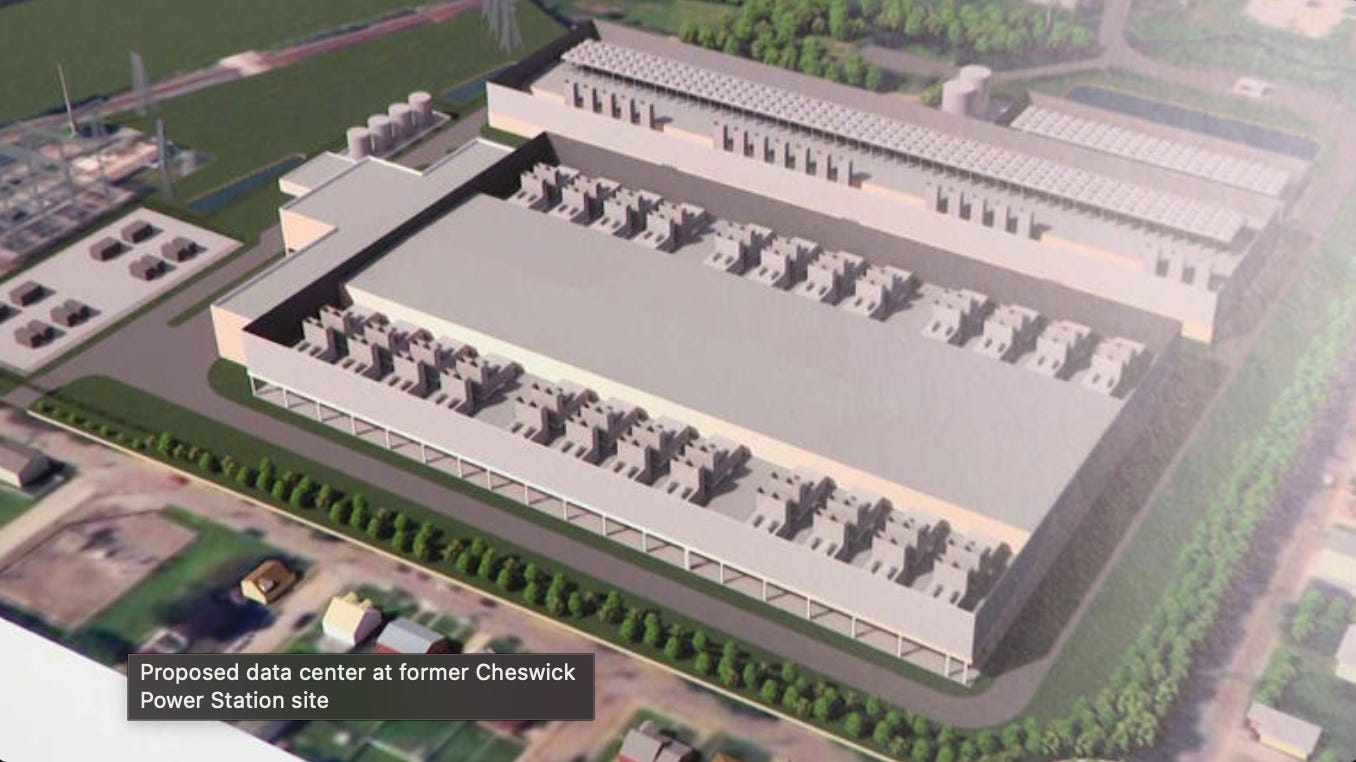
The dream of a Rachel Carson Center on the banks of the Allegheny River would vanish this May with reports that the 200-acre site had been sold to a “large multi-national experienced data center developer.” Fears that the riverfront site would be home to an energy sucking AI-data center were confirmed earlier this month at the August 6th meeting of the Springdale Planning Commission. Brian Regli, a representative of Allegheny D.C. Property Co., presented a proposal to build “a 565,000-square-foot hyperscale data center and a 200,000-square-foot mechanical cooling plant” on the site. The data center would be the size of PPG Paints Arena (home to the Pittsburgh Penguins) and consume enough energy to power 150,000 homes in a town with a population just above 3,000. While details on where that power would come from and what impact it would have on the local grid are lacking, most likely the energy will be generated by burning natural gas extracted through fracking in the Pittsburgh region. What could have been a site honoring a pioneer of the environmentalism movement and showcasing Springdale’s unique history would instead be home to one of hundreds of generic data centers sprouting up throughout the country, significantly straining our power grids and spiking carbon emissions that are already tipping our planet closer to a climate catastrophe.
It was no coincidence that the proposal for a Springdale “hyperscaler” came just a few weeks after the Pennsylvania Energy and Innovation Summit at nearby Carnegie Mellon University, attended by both President Donald Trump and Governor Josh Shapiro. The event announced over $90 billion in private investment, tapping into the Pittsburgh region’s prowess in producing both AI talent and fossil fuels. Trump’s interest in pushing an AI data center boom is no secret. His 2024 electoral victory was funded by a who’s who of billionaire AI maximalists like Elon Musk, Marc Andreessen, and Peter Thiel. The mind-boggling spike in energy usage required to fuel AI computing also throws an enticing lifeline for the Republicans’ most faithful donor base, the fossil fuel industry, whose drilling and extraction were supposed to be sunsetting this decade due to the rapid adoption of green energy. For centrist Democrats like Shapiro, backing the AI data center boom burnishes his bona fides with the Abundance faction of the party that believes we must build, build, build our way out of the inequities and inefficiencies of a stagnating American economy.
This bipartisan capitulation to AI dominance is not particularly shocking, given that nearly every one of the ten most valuable companies in the world is deeply invested in the race for Artificial General Intelligence. All other horizons of human creativity and innovation have darkened, with an unprecedented percentage of investment capital now wagered on a bet that machines will solve all the problems that their human creators (who do not fully understand the internal workings of AI) could not. The dream of a Rachel Carson Center in Springdale died due to the lack of vision, courage, and leadership of centrist Democrats like Shapiro, whose fealty to corporate donors prevents them from even considering economic growth that does not pad the profit margins of the already obscenely wealthy oligarchic class. While Shapiro has proven a tough enough fighter against the Trump Administration on issues like education funding cuts to receive the fawning coverage of liberal media like The View and The Colbert Show, he has been more a collaborator than a fighter against the corporate elites that have slashed work forces, polluted the environment, and hollowed out the heart of towns like Springdale. With no credible opposition to fight the Republicans’ drive to rape and pillage the natural world, AI maximalism will swallow up the social resources and political energy needed to build projects that could benefit the world as a whole, projects like a Rachel Carson Center in her hometown of Springdale.
A deeper look into the sad story of Springdale reveals an even more disturbing view into the corrupting influence AI money will play on the policies of both major political parties in the years to come. Brian Regli, the lead developer who pitched the hyperscaler data center to the Springdale Planning Commission, did not assume his role based merely on an understanding of AI computing and real estate development. His political connections undoubtedly propelled his ascension to a position that will have him pitching AI data centers all throughout Western Pennsylvania. As the Pittsburgh Tribune Review reported, Regli “served as executive director of the Office of Critical Investments in Gov. Josh Shapiro’s administration until April.” The fact that the lead developer was a former member of the Shapiro Administration confirms suspicions of the utterly amoral transactional nature of American politics, breeding a cynicism that often results in voters preferring the vulgarly flagrant greed of heartless Republicans over the thinly-veiled, two-faced greed of hypocritical Democrats. Under Shapiro’s “leadership” Springdale will likely lose its last best chance to honor its most famous resident, erasing its historical legacy, becoming just one of hundreds of American towns that will sacrifice their electricity, water, and unique character to be passive targets of profit extraction whose fate and future lie in the hands of the world’s most powerful corporations and wealthiest oligarchs.
“It is a wholesome and necessary thing for us to turn again to the earth and in the contemplation of her beauties to know the sense of wonder and humility,” Rachel Carson wrote in her essay, The Sense of Wonder. The spirit of the AI Revolution stands diametrically opposed to the sense of wonder toward the natural world that Rachel Carson hoped to inspire in her readers. AI enthusiasts instead seek to reorient our entire civilizational project toward a sense of wonder for all that is artificial, inhuman, and soulless, guided by a spirit of hubris rather than the humility urged by Rachel Carson. AI’s sense of wonder for the artificial leads us toward the destruction of the very natural world that gives us life, all in the naively arrogant belief that humans might give birth to a superintelligent being capable of undoing the unprecedented ecological destruction that brought it into existence.
Experts within the field of computer science routinely warn us that Artificial General Intelligence might destroy humanity and the earth itself, resulting in a silence more permanent, totalizing, and horrifying than anything Rachel Carson could have ever imagined. We should not forget that it was not inevitable fate but the deliberate choice of self-serving politicians that led us down this dark path, toward a bleak future where Springdale lies silent, except for the low, dystopian hum of a soul-sucking and energy-guzzling AI Data Center. A better world is possible, where the Springdale riverfront is alive with the buzzing of insects, the singing of birds, the laughter of children, and the conversations of environmental scientists from across the world. That world of natural beauty and fulfilled human potential will never come to pass until the corporate and political elites forcing the AI Revolution upon us are removed from power for good.