

“This Area is a Liberal Free Zone!!!” The words stretched across the banner are big and bold enough to read from the other side of Kittanning Pike Road. Over the past year, the house displaying this banner feels more and more like a cultural remnant. In the district I represent in the outer suburbs of Pittsburgh, the handful of Perma-MAGA properties have one by one removed all the signs and banners that once declared allegiance to Trump 24-7, 365. I now have to drive outside my territory to catch a glimpse of what is left of the “Liberal Free Zone,” marked by a tattered banner serving as a faded tribute to the shattered dream of MAGA ascendancy.
Two years ago, even the liberal elites of American legacy media were declaring Trump's return to the White House as a sign of a momentous cultural “Vibe Shift” to the Right. Reading The Atlantic or The New York Times in late 2024, you would have thought that the “Post-Liberalism” of conservative “intellectuals” like J.D. Vance and Patrick Deneen had percolated into mass culture with the help of Joe Rogan, Barstool Sports, and Wall Street Bets.
The supposed threat of America becoming a “Liberal Free Zone” from sea to shining sea was seized upon by centrist Democrats (and the professional consultancy class who do much of their thinking for them) to shift messaging and policy to the right in an effort to distance the Democratic Party from all things woke. Democratic Senator Elissa Slotkin implored Democrats to “fucking retake the flag” while lamenting that the Party was seen as “too weak and woke” and needed a more macho, militaristic rebrand. Other centrist pundits like Ezra Klein and Derrick Thompson promoted a pivot away from cultural politics altogether, focusing Democratic talking points on a technocratic, YIMBY maximalist Abundance Agenda of cutting through red tape and regulation to build, build, build. In 2025, centrists called for a strategy of retreat, retrenchment, and rebranding to ensure the Democratic Party survived the extinction-level threat of a Post-Liberal conservative Vibe Shift.
A year and a half later, Americans are returning to the polls. Nearly every political analyst is predicting a veritable Blue Tsunami, where the Democratic Party will not only survive but dominate the first Midterm election of this so-called Post-Liberal era. A vibe shift has, in fact, happened; but if America is truly moving past Liberalism, the direction is to the Left, not the Right. A year and a half of cruelty, corruption, and incompetence by the Trump Administration has left the MAGA coalition in tatters. The rightward shifts promoted in 2025 by centrist Democrats have been rejected across the political spectrum, a humiliating demonstration of their consultant and donor class handlers’ complete disconnect from the concerns of average Americans. The macho militarism of Elissa Slotkin failed to understand the growing anti-war America First sentiment on the right, which has turned against Trump’s capitulation to Israeli influence in funding the ongoing genocide in Gaza and the pointless destruction of an Iran War that has hobbled the economy at home and abroad. The corporate coddling doctrine of Abundance liberalism would also backfire before the end of 2025, as Americans from across the country rose up in resistance against a Data Center buildout. Abundance Democrats, like Josh Shapiro, have gone from unabashedly parroting the build, build, build mantra of Klein and Thompson a year ago to echoing the populist outcry against “predatory developers” in an effort to stay in step with an electorate that hates Data Centers by an overwhelming majority. The abject failure of Democrats to gain momentum by pivoting right on militarism and relaxing corporate regulation has proven that the consultant class that dominates the party was just as wrong about responding to the Trump 2.0 “Vibe Shift” as they were about crafting a winning message for Biden and Harris in 2024.
With the coming of the 2026 Midterms, it is now clear that if Democrats are to thrive in a Post-Liberal America, it is not by performatively shifting right on messaging, but by sincerely shifting left on policy. The most exciting and inspiring Democratic candidates in the 2026 Midterms have built upon the 2025 electoral success and formidable popularity of New York Mayor Zohran Mamdani to craft anti-establishment, anti-corruption, anti-oligarch messages with a Horseshoe Theory appeal strong enough to attract even hard-right former Trump voters. These candidates are not “Post-Liberal” in the sense that they have surrendered core liberal values such as protecting female reproductive freedom, safeguarding rights of minorities, supporting labor unions, or questioning the moral and economic cost of perpetual war. In many ways, the Post-Liberal Democrats of 2026 more stridently protect those values than the vast majority of establishment, corporate-controlled liberal Democrats. What makes these new Post-Liberal Democrats more formidable is their ability, in both style and substance, to transcend the liberal stereotype that Republicans have used as a cudgel to beat the Democrats into an impotent and incompetent center-Right party that has failed to protect the material interests of the average American for decades.
“Liberal” has been an epithet that has haunted the collective consciousness of the Democratic Party since George McGovern’s landslide loss to Richard Nixon in 1972. Exploiting the cultural fissure that broke out in the 1968 Democratic Convention between hippie student protestors and Richard J. Daley’s working-class Chicago PD, Nixon and the New Right positioned the “liberal” as a secular, urban, elitist out of touch with the average God-Fearing member of the Middle American “Silent Majority.” With the rise of talk radio and cable news in the 1990s, the word “liberal” would be cemented into popular discourse as a bogeyman who was anti-American, anti-Christian, and anti-Capitalist. Democratic strategy over the past 50 years has been focused on dodging the liberal label, from the nomination of Southern Baptist Washington outsider Jimmy Carter in 1976 to the pro-corporate, neoliberal policy shift of the Clinton White House in the 1990’s to the promise of Kamala Harris to equip America with the “most lethal fighting force” during her acceptance speech at the 2024 Democratic Convention. If there has been anything resembling a coherent strategy guiding the Democrats over the past half-century, it has been trying to prove to the coveted swing voter that their candidates should not be tagged with the dreaded label of “liberal.”
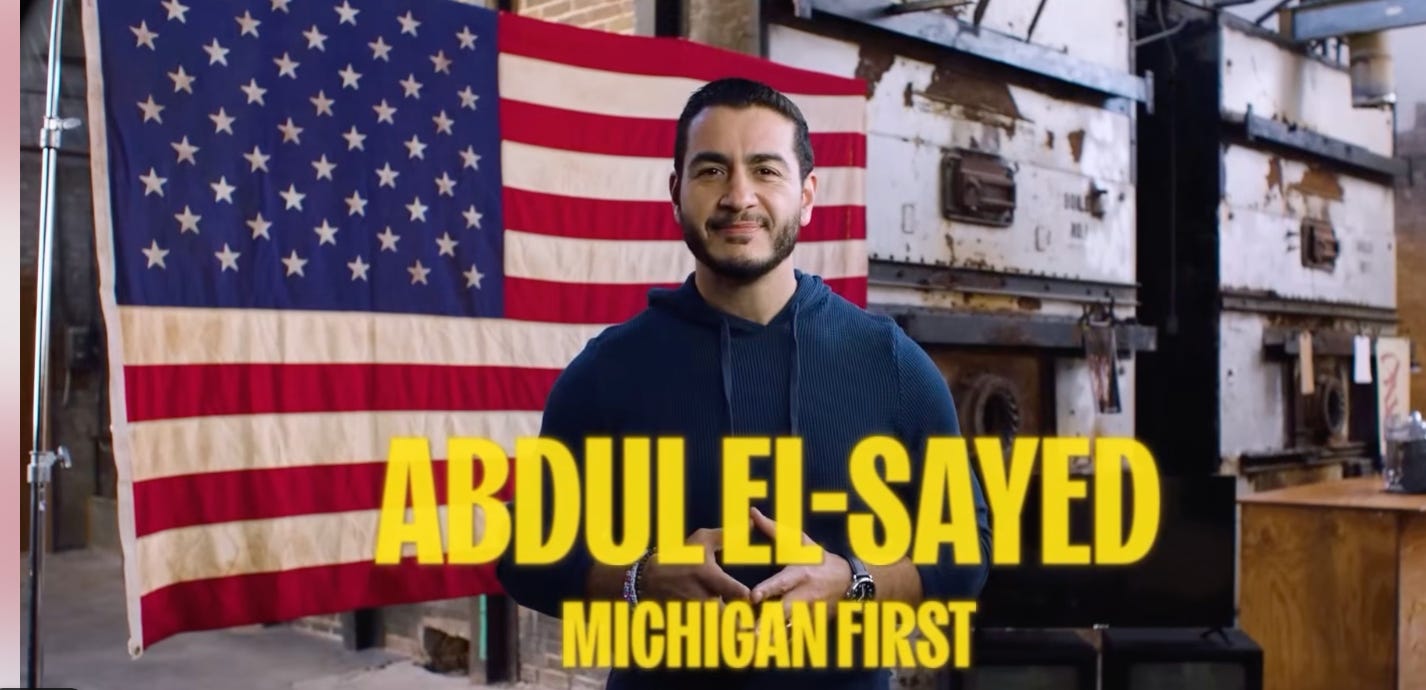
The Democrats leading the charge for a much-anticipated 2026 Blue Tsunami embody a “Post-Liberal” shift in the party not by compromising on core ideological principles but by authentically dismantling the Republicans’ stereotype of the liberal as a secular, urban elitist. Democratic Senate candidates like Abdul El-Sayed in Michigan, James Talarico in Texas, and Troy Jackson in Maine have taken up the mantle of anti-oligarch populism, relentlessly attacking the obscenely corrupt elitism of the Epstein-aligned Trump Administration, which has prioritized the interests of globalist pedophiles, crypto scammers, and AI accelerationists over the needs of the average American. Rather than secularists, many of the Post-Liberal Democrats are deeply religious, like the former Presbyterian seminarian Talarico and megachurch pastor Adam Hamilton, who has a fighting chance to be the first Democratic Senator elected from Kansas in almost a century. Shattering the urbanite stereotype associated with liberals, Democrats like Jackson in Maine and Iowa Governor candidate Rob Sand are from the smallest of small towns in rural America, lifelong gun owners whose authenticity stands in contrast to the highly engineered, 2nd Amendment cosplay performed by urban liberals like goose-hunting John Kerry in 2004 and Glock-toting Kamala Harris in 2024. In 2026, we have witnessed the emergence of Democrats who have cast off the cultural baggage of the stereotypical liberal without discarding the core ideological commitments of what it means to be a progressive.
The shift toward a Post-Liberal era in the Democratic Party is even being reinforced by their Republican opponents, who have switched the “liberal” label out for what they believe to be a much more menacing scare word, “woke.” Texas Republicans led by Senate candidate Ken Paxton can’t help but talk incessantly about Talarico’s 2021 proclamation that “God is non-binary.” Michigan Senate candidate Mike Rogers has dinged El Sayed for echoing the 2020 refrain to “defund the police.” We will find out soon whether the substitution of “woke” for “liberal” will do the Republicans more harm than good. Unlike “liberal,” which was an enduring marker of a core urban, elite identity, “woke” conjures a more ephemeral, passing phase of early 2020s discourse that those on the Left can disavow and distance themselves from in 2026. “Woke 1 was crazy,” AOC declared in August, and Talarico, for his part, has admitted that many of his early 2020s utterances now sound “cringey.” In a social media era where trends emerge and disappear within days, woke statements from half a decade ago seem like momentary lapses, verbal excesses from a bygone era, making the Republican attack on those positions and even the use of the term “woke” sound stale and desperate.
By switching their line of attack from the familiar yet enduring critique of “liberal” smugness to the more sensational yet ephemeral concept of “woke” extremism, the Republicans are making a high-stakes gamble. “Liberal” carried the baggage of careerist and opportunist Democrats who shape-shifted on policy commitments and sold out the common people when it suited their political self-interest. There could be no better example of the stereotypical soulless liberal than Haley Stevens, Abdul El-Sayed’s AIPAC-funded primary opponent, who endorsed Republican nominee Mike Rodgers just 48 hours before polls open in Michigan. For all its cringe excess, “wokeness” carries a connotation of sincerity and conviction utterly lacking in an establishment liberal like Stevens, whose political “success” was built solely on working her way up the party hierarchy since serving on the Hilary Clinton presidential campaign of 2008. With liberals like Haley Stevens, the Democratic Party doesn’t need liberals. It needs principled, passionate, and populist progressives to win in 2026 and redeem the soul of the party and lead the charge for the White House in 2028. When the polls close on Tuesday, Republicans may, in fact, find America has become a “Liberal Free Zone” after all, just one that is dominated by the Left and not by the Right.
Great piece, Jon, and I've missed you! :)
On Tuesday night, we'll get a lot of helpful data points, from both House and Senate races, about which types of Democrats are electoral overperformers. I think 2026 will end up being much more clarifying than 2018, which featured Democratic candidates who were generally in the same ideological mold.
Would you agree that some of the more moderate Democrats running for the Senate this year include Mary Peltola (Alaska), Josh Turek (Iowa), and Roy Cooper (North Carolina)?