


A couple of weeks ago, one of the weirdest Substack articles I’ve ever received popped up in my email inbox. The title of the article was, “A book that makes sense of our ‘hyper’ politics.” Dry, matter-of-fact, with e.e. cummings’ levels of capitalization, the subject line of the message resembled a group email book recommendation forwarded by my parents more than the title of a Substack piece by a former Congressman and aspiring Senator. But lo and behold, the email came from none other than Conor Lamb. And without even opening the message, I guessed correctly that the book “making sense of our ‘hyper politics’” was none other than Anton Jager’s Hyperpolitics: Extreme Politicization Without Political Consequences.
Hyperpolitics is no dense, abstract work of academic political theory. It’s a light, easy read of just over 100 pages. Like most books published by Verso, Hyperpolitics fits neatly into the more mainstream-adjacent edges of “far-left” political commentary. It’s not a hard subculture to access: just pick up the latest issue of Jacobin, queue Chapo Trap House for your podcast fix, stream HasanAbi on Twitch, get your news from Breaking Points, etc. I’m a longtime recreational user of the aforementioned leftish media, a philosophy major in undergrad, someone who got his start in electoral politics helping with Ralph Nader’s 2000 Green Party presidential campaign. Even without knowing how many Verso books I already have on my shelves, guys like me are the social media algorithms’ target demographic for marketing a buzzy book like Hyperpolitics. And the targeting has been fairly relentless the past few months, with numerous articles injected into my feed, from book reviews of Hyperpolitics in The Guardian to Jager opinion pieces in The New York Times.
I resisted at first, despite the outsized presence of Hyperpolitics in my quadrant of the social media galaxy. Something about the title and the premise of the book felt unoriginal. Jager’s conception of hyperpolitics as intense politicization without political consequence felt too close to Jean Baudrillard’s conception of the hyperreal as “models of the real without origin or reality” outlined in his 1981 classic Simulacra and Simulation.1 Granted, Jager openly admits Baudrillard to be his philosophical inspiration. But I was maybe even more irritated by Hyperpolitics’ similarities in theme to Adam Curtis’ 2016 film Hypernormalisation. A decade ago, Hypernormalisation described a political reality where we know our leaders are corrupt and the system is broken but feel helpless to change a world that is little more than make-believe simulation created by those who cling to power. Similarities to Hypernormalisation extended even to the cover art for Hyperpolitics, featuring a photo of a woman in a state of early 1990s rave bliss, an image that looked as though it had been a screenshot of the dreamy montages which are the stock and trade of any Adam Curtis documentary. But all my knee-jerk intellectual snobbery and informed consumer skepticism could not keep me from falling victim to the algorithm. Not long after reading the Guardian piece about how Hyperpolitics was “the book being devoured by the left,” I pushed the Buy Now button.
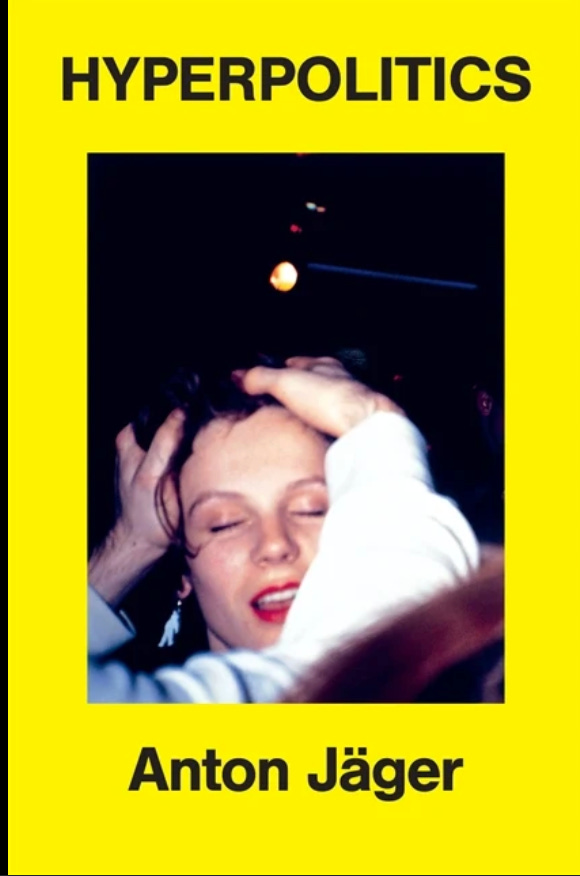
Before I could find the time and motivation to finish reading Hyperpolitics, the Conor Lamb Substack article materialized in my InBox. That’s weird. What the hell? I enjoy reading Lamb’s Substack as a window into the mind and soul of a normie centrist Democrat who I think is a pretty decent guy, despite having very different ideological positions from my own. And I knew Lamb eagerly joining the Substack community would expose him to a much more diverse array of political trends than he experienced during endless meetings with consultants, strategists, donors, and lobbyists while serving in Congress. But it was still bizarre seeing Conor Lamb, of all people, recommending the work of a self-described Marxist, even if doing so with all the intensity and enthusiasm of an 8th-grader giving a book report.
Once I saw Lamb refer to Hyperpolitics as a book being “devoured by the left,” it wasn’t hard to figure out how he “recently came across” Jager’s work. Probably someone, somewhere in the Conor Lamb extended universe, saw the Guardian article and impressed upon the former Congressman the need to keep up with the leftward-shifting winds within the Democratic Party. Platner may have lived down to Lamb’s abysmal expectations for the wayward oysterman; Francesca Hong and Oliver Larkin may have come up short in their primary campaigns, but the success of El Sayed, Mamdani, and the NYC DSA Congressional candidates has shifted the Democratic Party’s center of power so far left that even centrist politicians feel the need for a little radical chic makeover of their reading lists. Lamb’s “hey look, I’m reading Hyperpolitics” Substack piece functions like the newsletter version of sitting conspicuously in a cafe window, sipping iced matcha with the bright yellow cover of Jager’s trendy book visible for all to see.
Admittedly, I didn’t read all of Lamb’s piece - it was paywalled and accessible to subscribers only. I am not a paid Conor Lamb Substack subscriber. If I’m going to financially support any Western Pennsylvania politician eyeing a 2028 Senate run, those funds will go to Summer Lee or Chris Deluzio. But from what I could make of Lamb’s piece available outside the paywall, his effort to at least appear engaged in trending leftist thought marks a noticeable shift in the cultural posturing of the typical centrist corporate Democrat.
Not that left-fringe political theory hasn’t intersected with centrist Democratic politics in the past. Hillary had to account for her senior thesis on the work of radical rule-maker Saul Alinsky, and Obama had those house parties with Weatherman Bill Ayers to explain. Kamala Harris’ economist father was a left-leaning post-Keynesian economist (a “Marxist” by Donald Trump standards), and Pete Buttigieg’s dad was one of the main translators of Antonio Gramsci’s works into English. But when we think of cultural themes that defined the Harris and Buttigieg campaigns, there is a reason why Brat and High Hopes come to mind instead of the Labor Theory of Value or Cultural Hegemony. Over the last half century, leftism was something for Democratic politicians to dabble with in their youth, only to disavow in their maturation process toward becoming electable candidates, not a new special interest to dive into during their political reinvention journey on the way to a Senate run. For an old Blue Dog Democrat like Conor Lamb, performing the new trick of making leftist book recommendations has a bizarre Benjamin Button quality to it. This is not normal behavior for a centrist Democrat. Then again, these are not normal times for the Democratic Party itself.
So what the hell was going on? I decided to finish reading my own copy of Hyperpolitics in the hopes that Anton Jager might have some answers. The appeal of Hyperpolitics and the simplicity of its premise go hand in hand. Jager breaks the last century into 4 distinct political eras: (1) the mass politics era of disciplined, ideologically focused parties (1914-1989), (2) the neoliberal end-of-history-there-is-no-alternative-to-capitalism postpolitics era (1989-2008), (3) the antipolitics era of protest and populist outrage led by factions aggrieved by the Financial Crisis (2008-2020), and finally (4) our current era of hyperpolitics in which the political seems to saturate the entirety of everyone’s cultural and social lives yet make little lasting impact on the actual functioning of government or society (2020-2026).
While Hyperpolitics provides notable insights into the transitional states of postpolitics and antipolitics, the heart of the book centers around the contrast between our current state of hyperactive political impotence and the era of mass politics that won two World Wars, built the New Deal social contract, uplifted the American Middle Class, and established the United States as the dominant world superpower. “In contrast to the high politics of the years 1918 to 1989, hyperpolitics is an abidingly ‘low’ form - low commitment, low-cost, and all too often low value,” Jager explains. It is not hard to see Conor Lamb’s Substack book recommendation as a real-world instance of hyperpolitics itself in action: a low-commitment, low-cost, low-value gesture of performative engagement in the Democratic Party’s leftward shift without any commitment to advancing high-value progressive policies like Medicare For All, a Universal Job Guarantee, or a Wealth Tax. Lamb’s lack of commitment to the progressive policies of today does not prevent him from yearning for the era of mass politics, when Americans were deeply interconnected by institutions like unions and church congregations, wielding their collective power to advance the progressive policies of their day. As the scion of a prominent Irish Catholic political family, it’s not surprising that Conor Lamb identified with the wistful yearning for the New Deal mass politics era, a time when Democratic machine politics were built on the ethnic identities and union affiliations that brought his own family to power. Yet as a bank-lobbyist’s son, whose only main break from the Democratic establishment while in Congress was voting for financial deregulation, and who then went on to cheerlead Big Energy after redistricting, Conor Lamb is what Baudrillard might call “a pure simulacrum” of a New Deal Democrat, bearing “no relation to any reality whatsoever” conjured up by the golden days of mass politics.2
Conor Lamb and Anton Jager’s longing for mass politics in the age of hyperpolitics parallels what Baudrillard saw as the yearning for the real in the age of hyperreality: “paradoxically, it is the real that has become our true utopia - but a utopia that is no longer in the realm of the possible, that can only be dreamt of as one would dream of a lost object.”3 To prevent this current moment of insurgent leftism from being co-opted by the hyperpolitical whims of centrist politicians like Conor Lamb, we cannot forget that left-wing policies must be grounded in “the real,” i.e., tangible improvements in the material lives of the citizenry. Our era of hyperpolitics and hyperreality is defined by exhaustion from excess speech, surplus symbolism, a glut of hollow rhetoric and empty spectacle, what Baudrillard called “the overproduction and regeneration of meaning and of speech.”4 The “lost object” that we covet from the age of mass politics is the ability to touch with our hands and feel in our hearts the experience of political power being used to provide our neighbors food to eat, medicine to heal, homes to shelter, and work to give life meaning and direction. We want to build things again (infrastructure, public parks, monuments, quality housing, etc.) through the collective will of a government of the people, by the people, for the people, not through the “Abundance” mindset of lowering regulatory guardrails and juicing up tax incentives to fatten the profits of the parasitic developer class. This current leftist moment must also rebuild the institutions of civic pride and in-person political connection that fertilized the mass politics of America’s past. In other words, this current leftist moment will only succeed if it transcends the never-ending protests and social media signaling that defined the ages of antipolitics and hyperpolitics. Our leftist moment and our hyperpolitical era are locked in a kill-or-be-killed struggle. If the Mamdanis, the El Sayeds, and the AOCs are to leave a lasting mark on history, they will do so only by ushering in the end of this hyperpolitical era, proving that their collectivist, materialist projects are not just the empty simulation of a New Deal revival, but the dawning of a new high-value, high-commitment form of politics that can transform the world around us.
Like most left-wing books written in the 21st century, Hyperpolitics presents a problem without a clear solution. In his Substack recommendation, Conor Lamb seems drawn to Jager’s portrayal of hyperpolitics as a chronic and incurable syndrome plaguing our time without an easy fix or foreseeable exit. He embraces Jager’s explanatory framework, pointing to hyperpolitics as a phantom presence responsible for the “stagnant” politics that made his own tenure in Congress feel so underwhelming. Here we see the real risk of Jager’s Hyperpolitics perpetuating the very sense of futility and hopelessness he describes in the book, leading us toward an implosion of hyperpolitical energy and into a darker, more nihilistic era of postpolitics than what was experienced after the fall of the Berlin Wall. If we are to effectuate real change in this country, hyperpolitics as a concept will only be useful as a diagnostic criterion for an illness that we must cure through a more lasting, concrete, and substantive form of political action. We could paraphrase Karl Marx to provide some guidance to the likes of Anton Jager and Conor Lamb. We cannot be content to only interpret our era of hyperpolitics; the point is to change it. We cannot passively wait for hyperpolitics to end before seeking transformative economic change. We must make the material gains of progressive policy the self-authenticating proof that the era of hyperpolitical futility has ended. Only then will we begin a new era of politics that is far less hyper, and far more real.
Baudrillard, Jean. Simulacra and Simulation. Translated by Sheila Faria Glaser, University of Michigan Press, 1994. Page 1.
Ibid, Page 6.
Ibid, Page 123.
Ibid, Page 86.
Enjoyed this. Well done.
I read this as, "Do good work" instead of just talking about it and gesturing towards it. The performative nature of the book recommendation goes against the very idea of the book itself (from my understanding of what you are sharing).
It strikes me that the best way to effect change is at the hyper-local level.