

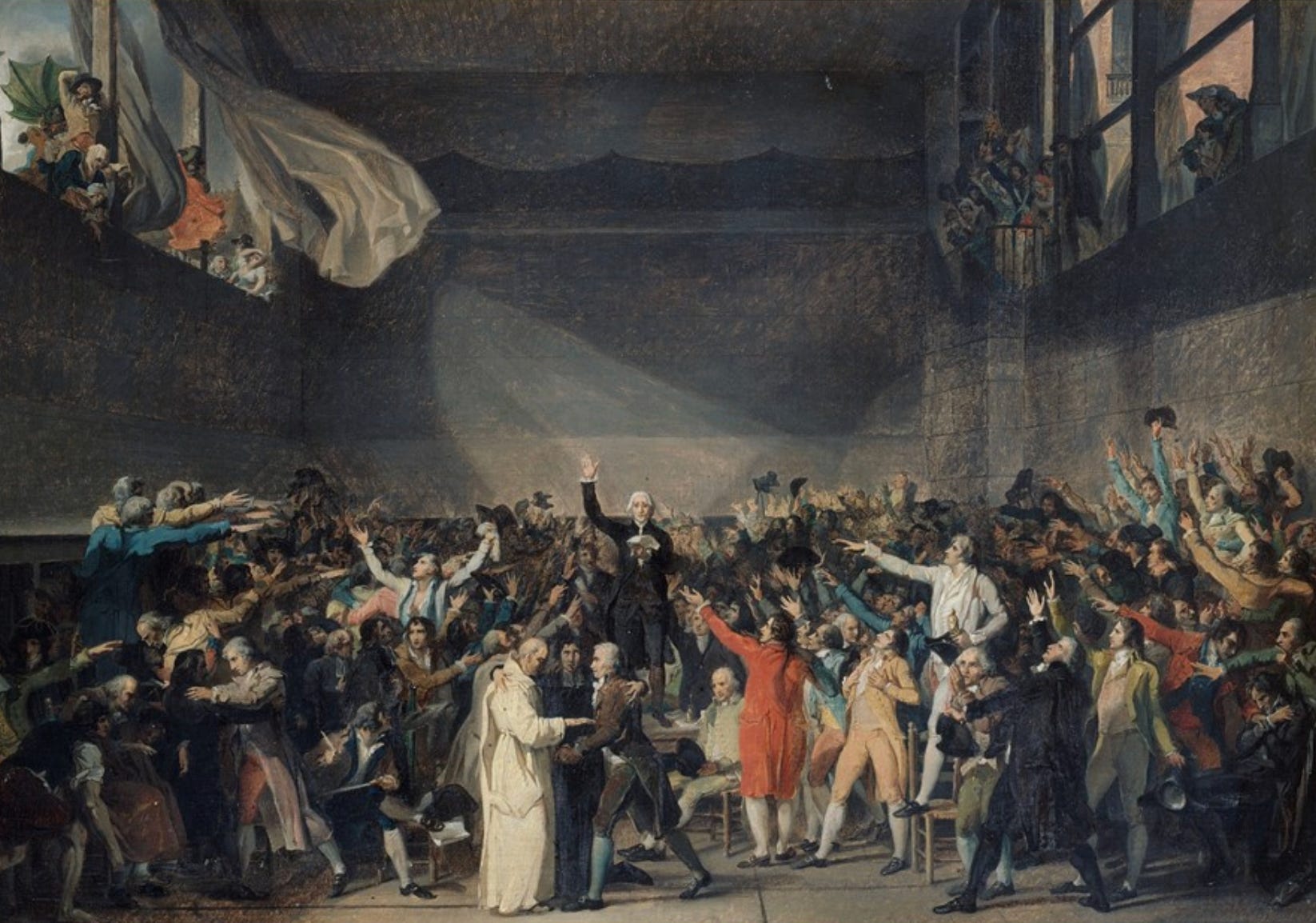
“The Second Estate was the official designation of the aristocracy of pre-revolutionary France. Members of the Second Estate enjoyed special privileges, including the right to hunt, carry a sword, and not pay taxes.” So reads the epigraph to Ray D. Madoff’s The Second Estate: How the Tax Code Made an American Aristocracy. The historical comparison Madoff makes between Ancien Régime France and our perversely unequal American society of today is an accurate one. Today’s billionaire class is just as feckless, debauched, useless, and corrupt as the nobility of pre-Revolutionary France. The French nobility amassed its wealth through special privileges and exemptions from taxes justified by the aristocracy’s essential role in preserving the social order, as they were touted as an indispensable link between King and peasant within the Great Chain of Being ordained by God. Anyone familiar with the United States Tax Code knows that our modern American billionaire nobility enjoys similar privileges and exemptions, justified by their supposedly essential role as “job creators,” “innovators,” and “change makers” propelling the limitless economic growth needed to preserve a social order divinely ordained by the Market.
Drawing on her expertise as a professor at Boston College School of Law, Madoff’s Second Estate provides a clear and compelling summary of the most egregious billion-coddling provisions within our United States Tax Code. In just 174 pages, Madoff analyzes the Tax Code provisions undergirding our cruelly unequal economic system, while also deftly dismantling the half-truths and obfuscations used by Republicans and centrist Democrats to justify policies that nourish the malignant mass of accumulated wealth growing within the American body politic. Madoff gives a rundown of all the worst tax policies that should be known by every American who wants to understand how our Tax Code has been the primary driver of income inequality since the Reagan Revolution of the early 1980s:
The Stepped-Up Basis Rule: Capital gains on assets held until an owner’s death are never taxed. This Tax Code provision enables the billionaire’s go-to Buy-Borrow-Die strategy: the ultrarich acquire stock, borrow against it as collateral for access to tax-free liquidity, and if they don’t sell before death, not a nickel of tax is paid on the capital gains accumulated while the asset was held.
Estate Tax Exemption: Gifts and inheritances go almost entirely untaxed because the Estate Tax does not kick in until an individual gives away at least $15 million or a couple gives away $30 million in assets. Despite the “Death Tax” hysteria whipped up by Republicans in the 1990s and 2000s, only 0.075% of estates pay any tax to the Federal government. All others pass wealth down tax-free, giving a huge advantage to those who inherit over those who work for their compensation.
“Pay Roll Tax” Deception: Payments made by workers into Medicare and Social Security are characterized as “contributions” even though the workers have no proprietary right to payments made into the system. An arbitrary distinction between Payroll and Income Taxes makes it possible for conservatives like Mitt Romney to claim 47% of the population pay no federal taxes, all the while rates on payroll taxes have increased over the past 50 years as income and estate tax rates have been slashed considerably.
The Carried Interest Loophole: Hedge fund, private equity, and venture capital managers pay long-term capital gains rates (usually 20% for high earners) on performance-based compensation instead of the ordinary income rate (usually 37% for high earners).
Charitable Giving Abuse: Elaborate trusts and Donor-Advised Funds shelter the wealth of billionaires from taxes while assets remain essentially within their control and directed toward minimal public benefit.
Madoff’s thorough but accessible analysis of these provisions should be required reading for anyone who wants to understand how our Tax Code perpetuates and exacerbates wealth inequality. Yet, while Madoff’s critiques of the United States Tax Code are undeniably accurate, they are certainly not novel. When I was a 2L at the UC Berkeley School of Law in 2003, Professor Eric Rakowski would rail against the absurd provisions that Madoff critiques in The Second Estate, from the stepped-up basis rule to the carried interest loophole. Awareness of these perverse handouts to the wealthiest Americans has not been limited to just students and professors at America’s most liberal law schools. Madoff discusses how Presidents Obama, Trump, and Biden all proposed closing the carried interest loophole and how Nixon and Obama both sought to end the stepped-up basis rule and impose capital gains on appreciated assets at the time of death.
If even supposedly the most powerful men in the world have been unable to dismantle the tax provisions critiqued in The Second Estate, what does Ray Madoff believe might inspire much-needed changes to our Tax Code? The closest thing to an answer provided by the book is the suggestion that we need “an intellectually honest, public discussion of what the tax system does for wealthy people.” The most charitable way to describe this answer is professorial - technically correct but completely out of touch with reality outside the walls of the law school lecture hall. From funding cable news networks, creating algorithmically-biased echo chambers on social media, buying up legacy newspapers, funding think tanks, and weaponizing Political Action Committees, one of the main ways billionaires have used their ill-gotten gains from a rigged tax code is to reengineer society and culture to make it functionally impossible for Americans to have “an intellectually honest, public discussion of what the tax system does for wealthy people.” You might say the Tax Code is the material base and the broader media ecosystem the cultural superstructure that fuses to create a government of, by, and for the billionaire class. Madoff thinking our Tax Code will change by Americans just having honest conversations about its most unfair provisions is as naive as suggesting the Second Estate in the 1780s could have been dismantled by just the good people of France having an intellectually honest public discussion about the unfairness of aristocratic privilege.
To make matters worse, rather than support more revolutionary means to dismantle our modern American Second Estate, Madoff mounts a decidedly reactionary attack on one of the most promising instruments available to fight the billionaire class, the Wealth Tax. Dismissing the Wealth Tax as a “gambit,” Madoff suggests the 2024 Supreme Court case Moore v. United States dooms any attempt to tax unrealized gains (i.e., the amount an asset has increased in value after it has been purchased but before it is sold). One of the most absurdly self-contradictory features of The Second Estate is that the same book whose title provocatively suggests we are in a state of pre-revolutionary wealth inequality completely dismisses the idea that even a Constitutional Amendment could be a realistic instrument for fighting modern aristocracy. If those who eventually destroyed the original Second Estate had the mentality of Ray D. Madoff, they would have gathered together on the royal tennis court of Versailles on June 20, 1789, decided that aristocracy was integral to the Great Chain of Being ordained by the Almighty, and all gone home after agreeing that creating a constitution for France was utterly impractical.
While Madoff’s constitutional concerns about a Wealth Tax are valid, even more concerning is her lending support to reactionary arguments that the Wealth Tax is too administratively burdensome to impose on the ultrarich. Madoff claims the Wealth Tax would feel “highly intrusive” to the wealthy. In a society where the wealthy amass stealth wealth through elaborate webs of shell corporations and offshore accounts while simultaneously trading on the private data of average Americans, Madoff fails to realize that imposing radical financial transparency against the rich is itself a justification for the Wealth Tax, and that the process is the punishment for decades of enrichment fueled by secrecy and deception. Moreover, in the age of agentic AI, it is ridiculous that Madoff thinks it too difficult for the ultra-rich to track their net worth every year when they are likely already doing asset valuations annually when renewing lines of credit, reviewing insurance coverage, or updating the cap table of venture capital-funded startups. Madoff being so easily duped by these arguments against radical changes in our tax system makes her opposition to a Wealth Tax look like devotion to her professional expertise in interpreting a grotesquely overbloated and needlessly arcane 7,000-page Tax Code, preferring to hunker down behind her academic moat rather than lending support for the use of what may be the most effective weapon available to subdue the modern Second Estate.
What makes Madoff’s commitment to technocratic, incrementalist reforms even more puzzling is that the historical narrative within The Second Estate points to the fact that progressive change in taxation only has happened in the wake of mass movements championing revolutionary change. “The most consequential tax reforms in the history of the United States have occurred when the country’s economic system was under threat, specifically, the threat of socialism and communism and their appeals to the working class (156),” Madoff writes, noting that the greatest impediments to these reforms of late have been “the intimidating nature of the tax code” and “disinformation campaigns” led by think tanks funded by the wealthy. The history of progressive American tax reform (and the history of the French Revolution for that matter) points not to the wonky tweaks promoted by Madoff but to a left populist movement based on radical transparency and the redistribution of wealth with immediate material benefit to the common citizen.
We cannot defeat the modern Second Estate through incrementalist edits to the Tax Code any more than the original Second Estate could have been defeated by incrementalist alterations to the aristocratic rights of the Ancien Régime. We cannot expect the average American to put “the country’s economic system under threat” simply by adding a Wealth Tax onto an already bloated and impenetrable Tax Code. We cannot expect change to happen by surgical strikes against the more reprehensible provisions highlighted by Madoff - if so, the presidents who flagged those provisions for elimination would have succeeded decades ago. We need to tear up the United States Tax Code and start again. In its place, I have advocated for a 10-page Tax Code, a radically transparent and accessible document that replaces the current Income Tax, Corporate Tax, and Payroll Taxes with a combination of a Wealth Tax, Consumption Tax, and Financial Products Trading Tax. The 10 Page Tax Code favors labor over capital, saving over speculation, and the production of material goods that promote human wellbeing over financialization and tech applications that cause more problems than they solve. Only a radical new 10 Page Tax Code fulfills the conditions Madoff notes are necessary for progressive reform. By relieving all Americans of tax upon their labor and freeing them from bureaucratic burdens inhibiting the starting of small enterprise, the 10 Page Tax Code has the potential to build the mass support needed to put “the country’s economic system under threat.” By scrapping all the complexity that perpetuates “the intimidating nature of the tax code,” the 10 Page Tax Code is immune from the disinformation campaigns used by the billionaire class to hide all their cushy perks hidden within the 7,000 pages of the current code while creating the false consciousness in average Americans that tax cuts at the top invariably serve the common good.
Only by offering a transparent new system that clearly benefits the material interests of the citizen will we create the popular momentum needed to overcome the practical and constitutional challenges blocking the progressive change advocated by Ray Madoff in The Second Estate. Sadly, Madoff prescribes reform when the title of The Second Estate suggests that our Tax Code is plagued by injustice that only a revolution can cure. The 10 Page Tax Code is the bloodless fiscal revolution America needs to chuck our billionaire class into the dustbin of history, where they can join the Second Estate French nobles who preceded them.
Note: If you would like to read The 10 Page Tax Code or help with the project, please send me a DM. - Jon
Major change in the tax code is part of a program of reforms that I believe will solve a lot of the problems facing our country. The package is repeal all tax cuts since 1996. This would make dividends taxed as ordinary income, as was the case before 2003. It would raise the capital gains tax rate to 28% and the corporate tax rate to 35%. Top income tax rate would rise to 39.4%. I would also change the definition of long-term capital gains from 1 year to 5 years. SEC Rule 10-18b creating a safe harbor for stock buybacks would be repealed. This structure gave us a balanced budget in 1990's. We have since created new Medicare and Medicaid liabilities from the situtation then that have not offsetting revenue stream. I would add new streams by eliminating the social security payroll tax limit and applying the 7.65% FICA tax on paychecks to all forms of income, interest, dividends, capital gains, rents, etc. The first $2500 of interest and dividend income would be excluded from all taxation including these taxes. I would also add two new ordinary income brackets at 750K and 2M income (indexed to GDP per capita) with 50% and 70% marginal rates.
FInally, I would change the 1934 Federal Reserve Act to permit the purchase of US Treasuries directly from the government, allowin us to move to nearly 100% of deficits financed directly by the Fed (i.e. monetization of the debt). This is likely to be highly inflationary if the government insists on running a deficit during economic booms, providing a strong disincentive for a party t cut taxes without first cutting spending, or adding new spending before raising the revenue to pay for it.
How do you implement this. First you need to induce a stock market crash. I think a core plan of raising corporate taxes back to 35% and capital gains rates to 28% that takes place in the following year will encourage investors to sell their stocks now to take advantage of the still low cap gain rates and buy back at lower prices next year. This should send stocks down. If we follow the 5 year long term definition, SEC rule change and repeal of the 2003 tax law you further reduce to the incentives of companies to send profits to shareholders (which would be used to buy up the market). This should keep the market heading down until panic can set in and do the rest of the job.
If a true panic can be produced, a mass demonstration of right and left wing groups opposed to Wall Street bailouts from thing like the 2008 TARP and especially Fed QE. They can carry placards with Secretary Mellon with the slogan Liquidate stocks, private equity and investment banks, and FDR with a say now to rule by organized money and the techlords.
Ordinarily massive liquidation such as we saw after 1929 would produce a Depression. But so would idling 1/6 of the nation's workforce as happened in 2020. We didn't get a depression then because the government applied massive stimulus to prevent it and the economic surged back. This also happened during WW II for the Depression. SO this is done and here were intoduce the debt monetization. Depressionary conditions will prevent immediate inflation. In both WW II and the pandemic, the stimulus was followed by inflation. The debt monetization will make the inflationary threat with recovery MUCH bigger. To avoid this much greater revenue will be needed so that when the stimulus is withdrawn as the economy recovers the deficit goes away with it. The rest of the tax increases proposed earlier are implemented here to deal with the terror of future inflation.
In other words, a situation must exist in which choosing to NOT implement the higher taxes will lead to total disaster for business and wealthy people (as well as the rest of us). This would create a willingness to raise taxes as actually happened in 1932, 1935 and the early 1940's. Basically, I am suggesting we implement something like the Depression-New-Deal-WW II sequence in a compressed fashion without impoverishing rank-and-file Americans for a decade and killing sixty million people.
The general theoretical stance behind my proposals is outlined here and elsewhere in my Substack.
https://mikealexander.substack.com/p/shareholderism
Here's a bit on the Wealth Pump, a metaphor for the process of rising inequality.
https://mikealexander.substack.com/p/operation-of-turchins-wealth-pump
I invite readers to check out the ideas proposed on my Substack (its all free) and discuss it.