
Draft Bust
The emptiness in the bank accounts of Pittsburgh’s small businesses after the NFL Draft left town reflects the emptiness at the heart of America’s K-Shaped Economy.

“‘Hey, snowmageddon is coming,’ then you get an inch of snow.” This is how Jeff Trebac described his experience last Friday as owner of Peppi’s Old Tyme Sandwich Shop, which has been serving subs to Pittsburghers since 1983. Without proper context, Trebac’s statement sounds absurd. Last Friday, the weather in Pittsburgh was about as gorgeous as it gets around here for late April: mainly sunny skies with highs in the low 80s. But what Trebac was describing was not the meteorological climate in Pittsburgh last weekend, but rather the city’s economic climate. The arrival of the NFL draft in the Steel City was hyped as an economic superstorm that would dump dollars by the foot onto vendors properly prepared to shovel up all the demand arriving on their doorstep. Instead, most Pittsburgh restaurants have shared the fate of Peppi’s, watching the NFL Draft blow through town without leaving more than a dusting of revenue on their overstaffed, overstocked establishments.
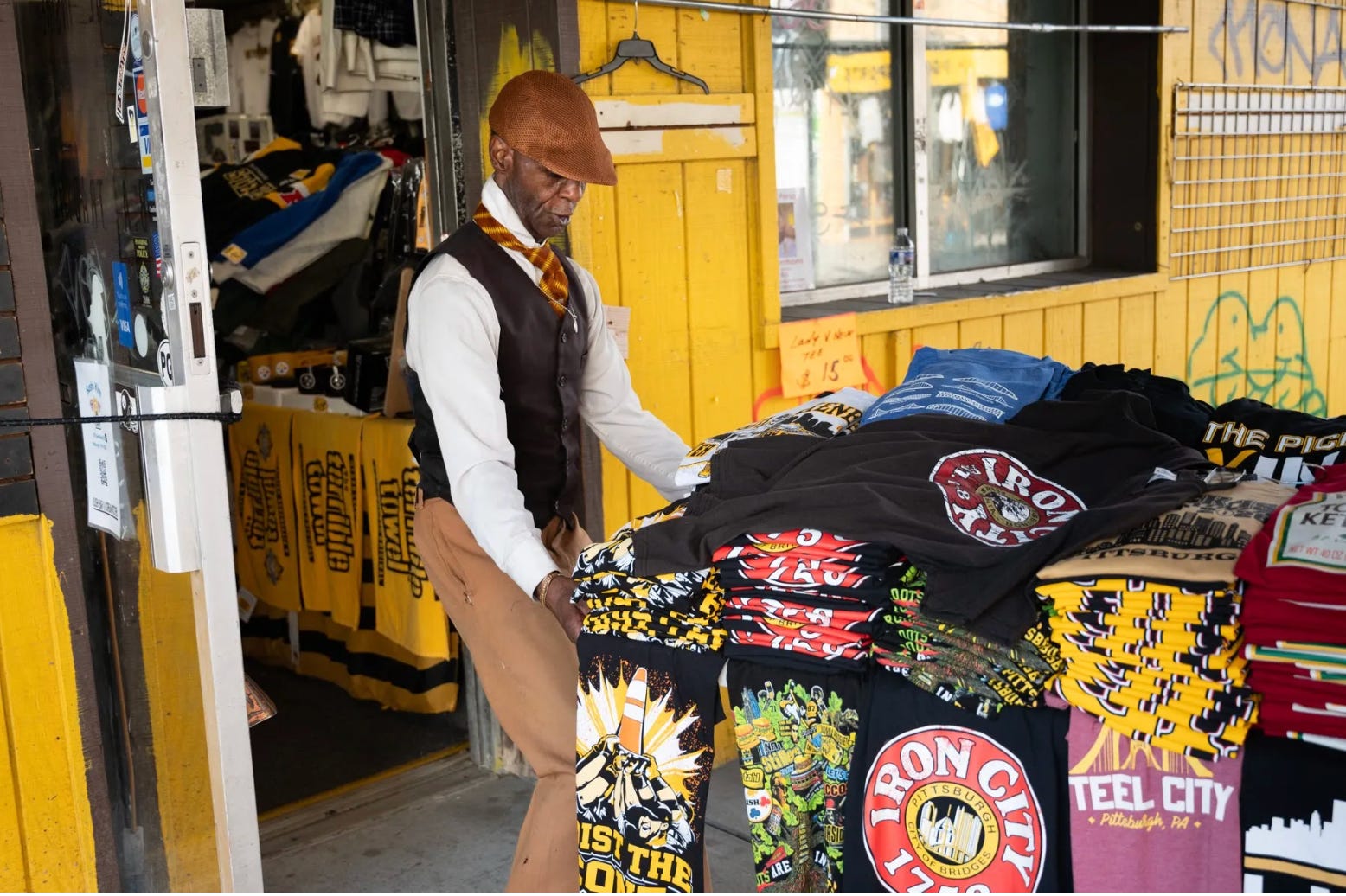
Disappointing sales were not confined to just restaurants. According to the Post-Gazette, “Pittsburgh’s NFL Draft hosted record-breaking crowds over the three-day event, but many local small businesses said their sales were lower than ever.” Take a moment to ponder that statement. Not only were sales disappointing compared to overblown expectations set by the NFL and public officials who pumped up the event, but sales were also disappointing compared to any average weekend. T-shirt vendors sat lonely in their stores, surrounded by mounds of unsold NFL gear. AirBnB hosts watched their properties go unbooked despite repeatedly lowering their prices from the once-in-a-lifetime rates they were told were sensible during the lead-up to the draft. Uber drivers were left sitting on the side of Pittsburgh streets without pick-up requests from riders. Even jewelers and juicers granted pop-ups near the beating heart of the Draft Red Zone found their sales lackluster and their prime positioning within the crowds not worth the squeeze.
While local small businesses told dark tales of unsold supplies and unmet expectations, the economic picture painted by the NFL and local politicians was bright and sunny. The NFL announced that Pittsburgh shattered Detroit’s previous record, attracting an unprecedented 805,000 attendees over the weekend, the most ever for an NFL Draft Host City. Governor Josh Shapiro praised Pittsburgh for putting on “a hell of a show,” while city and county representatives have not revised their bullish expectations that the Draft will bring in $125 to $200 million in revenue to the region.
So where is the disconnect? How can the political and business elites remain so cheery about the Draft while Pittsburgh’s small businesses report so much doom and gloom? The easy answer is that the NFL and the politicians are peddling their usual self-serving narratives and statistical fabrications. The NFL’s official number of 805,000 attendees double-counts anyone who showed up to watch draft events on multiple days. Meanwhile, it is no surprise politicians feel the pulse of economic dynamism when they are schmoozing with the wealthiest and most powerful visitors to the city, attending soirees in public spaces that have been beautified thanks to tens of millions of dollars in taxpayer money spent to make Pittsburgh more attractive to the investor class.
Still, merely suggesting that the NFL and the politicians are callously out of touch with the common man fails to do justice to the deeper structural forces that have led to two radically different experiences of the Draft’s impact on Pittsburgh. The story of Draft disappointment is not so much a story of the NFL failing Pittsburgh as much as it is a story about the American economy failing everyone but a small, increasingly powerful elite. The widening divergence between the prospects of the rich and everyone else in post-COVID America has given rise to financial journalism’s buzzy catchphrase, “K-Shaped Economy.” Using the Letter K as a visual model, the rising wealth of those already at the top is represented by the top arm of the K. The declining economic prospects of the middle and lower classes are represented by the downward direction of the K’s lower arm. Overall economic growth is increasingly dependent on the consumer spending habits of a moneyed class, whose fortunes are less and less tied to income, driven instead by the inflated values of their assets and investments. The rest of America is working more and more jobs for less and less share of economic output, their spending decisions driven by a frenzied search for affordability as inflation gnaws away at their savings and real wages. The phrase K-Shaped economy is an antiseptic, Sesame Street-style way of describing our grim reality of living in two Americas whose economic fortunes are not only decoupled but potentially in deep contradiction with one another.
You don’t have to squint to see a K-shaped formation in the story of the 2026 NFL Draft’s impact on the economy of Western Pennsylvania. From their sunny perch on the top arm of the K, it is no surprise that business and political leaders regarded the Draft as a smashing economic success. Wealthy draft attendees booked the top hotel suites downtown months ago at over $2,000 a night, never even giving a thought to booking an Airbnb in one of Pittsburgh’s quirky, historic neighborhoods. They didn’t need Uber drivers when they had private black car service, and they would never grub their way through the discount t-shirt vendors in the Strip District when official top-end NFL merchandise purchased at the Draft Campus fails to make even the slightest perceptible dent in their budget. Better yet, they might even just be gifted Draft Merchandise in a swag bag handed to them at a VIP event, where they would be served the best cocktails and entrees the city has to offer. Why would they want to grab an Italian sub at an old-fashioned sandwich shop when they have their private chefs to make them lunch and the best chefs in Pittsburgh to make them dinner? And how could these VIP Draft attendees even stumble into a humble neighborhood small business at all when they are being whisked around town by local politicians eager to lure their investment dollars into economic development? “I’ve actually spent most of my time not doing football, but trying to entice these business leaders to set up shop here in Pittsburgh,” Governor Shapiro proudly told KDKA news when describing his Draft experience. So long as public officials like Shapiro see the proper function of political leadership as using public money to make for-profit ventures more enticingly profitable to an investor class that already has too much money, there is little hope we can reverse the economic divergence that defines the K-shaped economy. Pampering the investor class does, in fact, drive our K-Shaped economy, but it also drives a widening wedge between the haves and have-nots in an obscenely unequal America.
The darker, grittier perspective from the bottom arm of the K provides insight into why the Draft ended up being an economic bust for most of Pittsburgh’s small businesses. The same NFL hype machine that fueled dreams of once-in-a-lifetime profits for restaurateurs, short-term rental managers, Uber drivers, and parking lot owners also spawned nightmares in the minds of middle and lower-income football fans who feared watching the draft in person might vaporize several months’ paychecks. With affordability the key driver on the bottom half of the K-shaped economy, cost-conscious NFL fans made rational decisions that starved Pittsburgh's small businesses of revenue. Rather than book a charming Airbnb on the North Side’s Mexican War Streets for $700 a night, they booked Hampton Inn rooms 20 miles out at a fraction of the cost. Rather than Uber around the city, they drove their own vehicles to a park-and-ride lot and took the Pittsburgh Rapid Transit service provided free through a partnership with Sheetz. Transported directly to the Draft Campus, they had little opportunity to frequent the restaurants and apparel shops in the surrounding neighborhoods, especially when they could opt for more budget-friendly options like packing a homemade lunch and buying cheaper merchandise from an online seller through their phone. Any small business owners that could not seduce the cost-insensitive top arm or scrounge some dollars away from the cost-obsessed lower arm found themselves in the lonesome, desperate center of a hollowed-out K-shaped American economy.
Pittsburgh is nothing if not resilient. Pittsburgh's small businesses are an even scrappier subset of broader cultural grittiness. Most vowed to soldier on and work harder despite the disappointments of an NFL Draft bonanza that will never materialize in their April 2026 cash flow statement. If they are Pittsburghers, they have cut their teeth on repeated disappointments. The 2026 NFL Draft is just the latest in a long line of transformational national spotlights that were supposed to help Pittsburgh shed its Rustbelt image and open everyone’s eyes to how beautiful, charming, and friendly our town really is. There were multiple awards crowning Pittsburgh as not only one of the most livable cities in America but also in the world. There was the 2009 Pittsburgh Summit, when the Obama Administration showcased our city as the symbol of postindustrial resilience to all the world leaders representing the G20. There was the mid 2010s hype of “Roboburgh,” when Carnegie Mellon’s status as one of the world’s greatest educational institutions for Artificial Intelligence promised to transform Pittsburgh into a tech powerhouse. If the AI industry really delivered on its 2010s promises of job creation, Pittsburgh would be an economic behemoth by the mid 2020s. Instead, a decade later, even as AI is devouring the American economy whole and our city remains as charming and livable as ever, Pittsburgh still struggles to attract the kind of investment and immigration needed to truly turn the corner after decades of demographic decline.
Cyberpunk author William Gibson once said, “The future is already here - it’s just not evenly distributed.” Most Americans will be reassured by a narrative explaining the failure of Pittsburgh’s small businesses to capitalize on the 2026 NFL Draft as just a product of our city's struggle to escape its industrial past, just another instance where the Steel City gets the short end of the stick in the distribution of America’s future. But as our national economy becomes ever more K-Shaped and dependent on the success of Artificial Intelligence, there is a more disturbing interpretation of last weekend’s Draft, one that sees the future as now being disproportionately distributed in Pittsburgh’s favor. All the world class AI talent, all the affordable real estate options, all the rankings as a great place for young singles, all the picturesque cliffside vistas, all the James Beard nominated chefs, all the Perks of Being Wallflower wow factor of America’s most scenic “front-door” entrance, all the regional assets that are supposedly keys to success in the 21st century American economy are not sufficient to make Pittsburgh vibrant enough to support a thriving small business ecosystem. The failure of the NFL draft to bring a windfall to Pittsburgh’s small businesses is not a story of a town stuck in the past, but the story of a town that has already positioned itself to be part of a K-Shaped future in the Age of AI, the kind of future that promises only more and more disappointment to all but a smaller and smaller sliver of the American people. The future of America is already here in Pittsburgh, and that future is unequal, uninspiring, and unfulfilling.